

A Senior Engineer’s Playbook for Custom Software Development

If you build software for a living, you already know the difference between something that merely ships and something that moves the business. Custom software development is where that gap shows up in the sharpest relief. Off-the-shelf tools plateau, spreadsheets fracture, and integrations creak under real-world scale. When leadership asks for speed and certainty at the same time, process theater won’t save you. Experience, tradeoffs, and a playbook that respects the messy reality of teams and markets will.
Across years of launches and rescues, one lesson repeats: your architecture, delivery motion, and product decisions only matter if they flow from a crisp business problem and a measurable ROI model. That’s not a slide—it’s a constraint you can design to. In the pages below, I’ll share how senior teams approach discovery, architecture choices, delivery mechanics, analytics, risk, and vendor fit so custom software development turns into a compounding asset rather than a fragile one-off.
Custom software development is a business decision, not a backlog
Too many initiatives start as lists of features with no grounding in the economics of the problem. Reverse the flow. Begin with the specific constraint you’re trying to relax—conversion friction, lead time to onboard customers, manual ops burn, compliance fines—and quantify the cost. Now your custom software development effort has a baseline. Tradeoffs get easier when you can compare dollars saved or revenue unlocked against the cost of scope and delay.
Stakeholders respond to clarity, not velocity theater. A simple model—unit economics, projected adoption, and a 12–24 month cashflow curve—beats ornate roadmaps that pretend certainty. Tie every epic to a measurable signal: what decision will downstream teams make differently when this ships? When the answer is vague, pause and simplify.
Scope ruthlessly. Your first release isn’t a referendum on ambition; it’s a wedge that proves value. Designers and engineers should work in the same narrative, not throw artifacts over a wall. When that’s hard to create internally, partner with a team built for end-to-end outcomes. If you need a partner who treats business context as a first-class input, start with discovery around outcomes, not tickets; see how we frame it here: https://new.flykod.com/services/custom-development.
Custom software development strategy: from problem framing to ROI
Strategy is choosing what not to do, under pressure. A credible plan translates business constraints into a sequenced set of bets that minimize regret. For custom software development, that means mapping value increments to uncertainty reduction. Start with the riskiest assumption first and attach it to a small, observable release. You’re trying to reduce variance faster than you spend capital.
Think in systems, not features. Each increment should improve at least one of: acquisition (lead flow, conversion), activation (time-to-value), retention (habit formation, NPS), revenue (ARPU, expansion), or cost (unit operations, error rates). If you can’t trace a line from a capability to one of those, you’re gold-plating. Commit to a cadence of business reviews where engineering, design, and operations interrogate both delivery metrics and commercial outcomes. It keeps the feedback loop honest.
Strategy also sets the social contract of pace. If you need tight iteration, bias toward a modular monolith and fewer moving parts to start. If you need independent timelines for teams, pay the orchestration tax earlier with stronger boundaries. No architecture is neutral; each encodes a financing model. Mature teams make that explicit so stakeholders understand why certain decisions look slow now to be fast later.
Discovery that de-risks scope, budget, and timeline
Discovery is not a workshop; it’s an evidence-gathering sprint that pays back across the project. Begin with journey mapping and shadow the frontline. You’ll rarely regret an extra day spent in the support queue or with sales engineering. Patterns surface: workarounds, brittle handoffs, data you wish you had. Turn those into testable problem statements and precise acceptance criteria.
Prototypes should answer the questions that words can’t. High-fidelity click paths reveal complexity and align stakeholders on behavior, not just screens. I like to cap prototype effort to a fixed budget and timebox, because anything beyond that becomes speculative design debt. When the user model stabilizes, sequence your epics by risk and dependency, and tie each to exit signals. If the behavior you need can be validated with a thin slice and manual operations behind the scenes, do it.
Quality discovery demands a shared design language. Pick a UI system early and invest in tokens and components so engineering doesn’t pay a tax with every screen. If you need a partner to formalize the bridge from UX to build-ready systems, align it with https://new.flykod.com/services/website-design-and-development. That handoff, done right, cuts weeks of rework and anchors a maintainable front end.

Choosing the right architecture for custom software
Architecture is debt allocation. Every boundary you draw decides who can move independently and what you’ll pay in coordination. The industry loves microservices, but independence isn’t free. If your change rate is concentrated in a few domains and your team is small, a well-structured modular monolith with clear module boundaries and contract tests lets you ship faster with fewer failure modes. As the organization scales, you can extract seams intentionally, rather than scattering services prematurely.
Data gravity should steer your design. Keep the write path simple and resilient; tolerate more complexity on the read side if you must. Avoid letting analytics needs contort your domain model—use streaming or CDC into a warehouse for downstream insight. Consider a service mesh and event-driven edges only when your governance maturity and observability budget can sustain them. For a balanced perspective on service decomposition, Martin Fowler’s classic write-up is still worth your time: https://martinfowler.com/articles/microservices.html.
Tech stacks are means, not identity. Choose boring where it lowers risk: a mainstream database over an exotic one, a widely adopted framework with good tooling, and cloud primitives you can hire for. Opinionated doesn’t mean edgy; it means consistent. Establish standards for logging, tracing, and metrics on day one so the first incident is instructional, not existential.
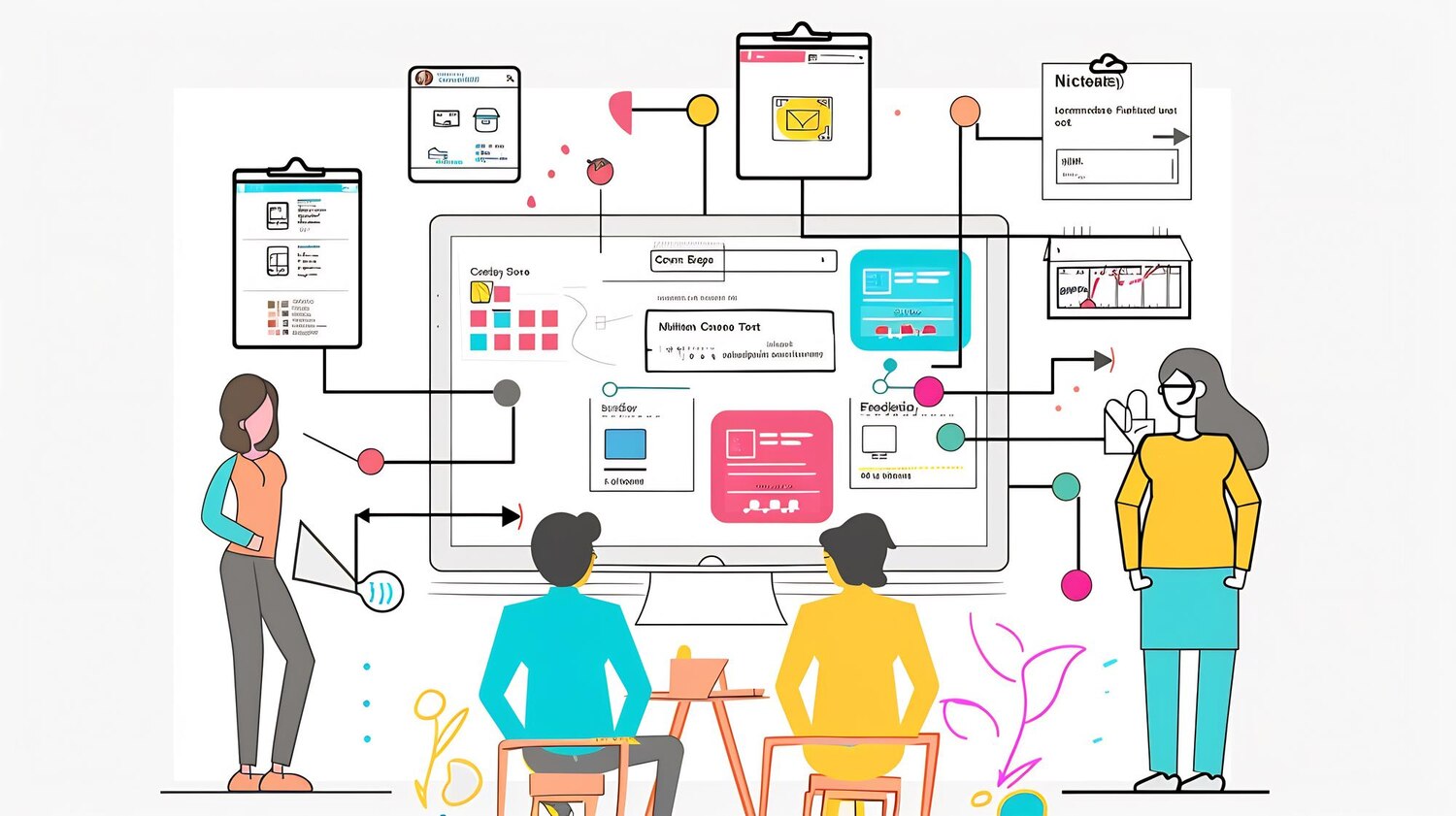
Build vs buy vs integrate — a decision framework
Reinventing wheels wastes capital, but gluing the wrong wheels together wrecks the car. The smart move is a layered approach: buy for well-defined commodities (auth, billing, search), integrate for cross-system workflows where vendors have surface area, and build where your competitive advantage lives. The calculus changes with scale and compliance posture, so revisit decisions as constraints evolve.
Run a quick decision loop before committing:
- Define the edge: Is this capability a differentiator or hygiene? If it’s hygiene, bias to buy.
- Map total cost: License, integration, data egress, operational overhead, vendor risk, exit cost.
- Assess velocity: Does a vendor accelerate learning now without boxing us in six months from now?
- Establish ownership: Who will run, debug, and renew it? If nobody owns it, it will own you.
- Plan the exit: What would it take to replace or internalize this later?
Most modern stacks thrive on strong integrations—webhooks, queues, and idempotent APIs. If you need help orchestrating third-party services around your core system, invest early in automation that treats APIs as first-class citizens. The payoff compounds; for reference, see https://new.flykod.com/services/automation-and-integrations. Custom software development succeeds when you spend your smartest cycles on the differentiator and buy runway everywhere else.
Delivery mechanics that actually ship — pipelines, testing, and DORA
Everything good in delivery starts with small batches and ruthless automation. Trunk-based development, fast CI, and a clean artifact pipeline keep the feedback loop tight. Measure lead time, deployment frequency, change failure rate, and mean time to restore—DORA metrics are boring precisely because they work. If yours sag, it’s rarely about tooling; it’s usually a batch-size or ownership problem.
Test strategy mirrors risk. Don’t start by unit-testing getters; begin with contract tests at the seam between modules and a few high-value end-to-end flows. Add property-based tests for critical transformations; layer in fuzzing where inputs are adversarial. For front ends, story-driven component tests pay off because they also serve design review. Performance tests should live in CI too; slow is a bug you can catch early.
Release with confidence. Blue/green and canary patterns, feature flags, and database change discipline (expand/migrate/contract) de-risk change. Observability is your seatbelt: structured logs with correlation IDs, traces that include user and tenant, and dashboards wired to leading indicators, not vanity charts. When incidents happen, blameless postmortems and a follow-through backlog keep learning compounding instead of treating outages as freak events.
Data, analytics, and performance from day one
Product conversations lose power without data you trust. Define a minimal analytics plan early: what questions will you ask at each milestone, and what events or metrics answer them? Wire event tracking with a contract mindset so changes don’t corrupt longitudinal analysis. Keep PII separate and encrypted; pass only what analytics needs. A warehouse and a lightweight semantic layer pay off quickly when you’re answering the same questions weekly.
Performance is a feature, not a postscript. Start with budgets (TTFB, LCP, p95 API latency) and wire them into CI. Measure server-side and client-side; the user doesn’t care where you were slow. Cache behavior should be intentional, not tribal knowledge; document cache keys and invalidation norms like you would an API. The same goes for data retention and archival: know what you can delete, when, and why.
Teams that make analytics and performance first-class citizens spend less time arguing and more time deciding. If you need a structured path to instrument, analyze, and tune your system, align with a partner that treats insight as a deliverable, not an afterthought. A good starting point: https://new.flykod.com/services/analytics-and-performance.
Security, compliance, and operational resilience
Security posture is built choice by choice, not via a quarterly audit scramble. Start with a practical threat model: actors, assets, entry points, detection, response. Bake security into the pipeline—dependency scanning, SAST/DAST, and signed artifacts—so regressions are hard to introduce and easy to catch. Least privilege should be a default, not a later patch. Rotate keys, isolate secrets, and log access centrally.
Compliance is easier when architecture respects boundaries. Data residency, consent, and right-to-be-forgotten are simpler when PII isn’t smeared across services. Add chaos and failure exercises to prove your assumptions under pressure: kill pods, throttle networks, rotate certificates in staging, and measure blast radius. Incident rehearsal isn’t paranoia; it’s professionalism.
Resilience is also about people. Runbooks that engineers trust, on-call that’s humane, and alerts that are specific prevent burnout and improve MTTR. When a regulator or enterprise customer asks for proof, you won’t scramble—you’ll export yesterday’s evidence. Custom software development becomes a credible asset when it can withstand both market spikes and bad days.
Measuring custom software development ROI — signals, metrics, and dollars
ROI is not a quarterly surprise; it’s designed into the system. Tie each epic to a leading indicator (adoption, task completion, error rate drop), a lagging outcome (revenue, margin, churn), and an explicit observation window. Instrument the baseline before the first release so you can attribute change to the thing you shipped, not to sentiment. Keep a running model of cost-to-serve so savings are visible, not hypothetical.
Relentlessly prune. If a feature doesn’t move its metric in the timebox you set, either adjust the bet or retire it. Sunsetting is a strength. On revenue work, model pricing experiments into the build plan so you don’t need a separate project to test them. In commerce scenarios, make sure your platform allows for segmentation and rapid offer testing; if you’re formalizing that capability, see https://new.flykod.com/services/e-commerce-solutions.
Report like an owner. A one-page monthly review—money in, money out, metrics moved, risks emerging—beats verbose decks. Custom software development deserves the same financial clarity as any capital investment. When leadership sees the link between commits and cash, the budget conversations grow up fast.
Team models, vendor fit, and long-term ownership
Great outcomes come from clear ownership and aligned incentives. Staff augmentation without product leadership is a false economy; you’ll rent hands while starving the brain. A cross-functional team with product, design, and engineering accountable to one outcome moves faster and makes fewer irreversible mistakes. If you do bring in a partner, align on who decides what, how tradeoffs are recorded, and how knowledge flows back to your team.
Vendor fit is about posture, not just portfolio. Look for teams that say no, who cut scope without drama, and who treat your environment as a system. Ask to see their postmortems and their approach to versioning, documentation, and handover. You’re not buying code; you’re buying an ability to make decisions under uncertainty and leave you stronger than they found you. Brand matters too. Consistent visual language accelerates trust with users; if you need help aligning product surfaces with identity, take a look at https://new.flykod.com/services/logo-and-visual-identity.
Plan the afterparty on day one. Define maintenance budgets, release cadence, and internal champions. Capture architecture decisions in lightweight docs (ADRs), tag backlog items by decision dependency, and keep a living map of integrations and data flows. A healthy exit plan is a sign of respect for your future self—and it keeps partners honest.