

Custom Software Development: The Pragmatic Field Guide

Projects don’t fail because teams can’t write code. They fail when scope drifts, decisions go unowned, and product intent gets watered down by compromises no one remembers making. Custom software development is how you get out of that spiral—by deciding what matters, designing for change, and shipping increments that you can stand behind in front of customers and the board. After two decades delivering platforms that handle money, patients, freight, and everything in between, I’ve learned that technology is the easy part when the hard decisions are made early and revisited often.
What follows isn’t a tutorial. It’s a field guide for product and engineering leaders who actually carry P&L responsibility. We’ll cover how to pick the right problems, how to scope without fantasies, which architectural choices age well, why delivery mechanics matter more than any single framework, and how to price and govern without setting traps for yourself. The goal is predictable outcomes with room to adapt—because your market will change while you’re building.
What Custom Software Development Really Solves
Software doesn’t create value by existing; it creates value by removing constraints. Off‑the‑shelf tools remove generic constraints. Custom work removes the ones that make your business different. Think about your unique pricing logic, how you qualify leads, how you allocate inventory under pressure, or the compliance nuance your competitors gloss over. Those edges are where custom software development pays for itself. When we aim it at differentiators, it becomes a leverage multiplier rather than a cost center.
There’s a trap in equating “custom” with “reinvent everything.” Reinvention makes sense only where the market refuses to serve you. Elsewhere, compose. Stitch together proven components, then implement the seams that carry your special sauce. It’s not glamorous to spend two weeks integrating identity instead of rolling your own auth, but it’s the kind of decision that keeps delivery dates from slipping and auditors from loitering in your Slack.
Executives often ask for a guarantee that users will love the first release. That’s the wrong question. The right one is whether the first release reduces uncertainty. A good v1 narrows the solution space around your differentiators. It approaches risk like a portfolio—small bets where the unknowns are highest, bigger bets where the payoff is clear. Approached this way, custom software development becomes a disciplined engine for learning and compounding returns rather than a moonshot that depends on luck.
Custom Software Development Strategy: From Idea to ROI
Strategy in software is a series of choices you’re willing to defend. Start by naming the business outcomes that matter—fewer support tickets, faster quote-to-cash, higher conversion from trial to paid, tighter inventory turns. Translate those outcomes into behavior changes you can observe, then design for the smallest release that can trigger the first measurable shift. That’s the hardest part: cutting ruthlessly without losing the thread of the story.
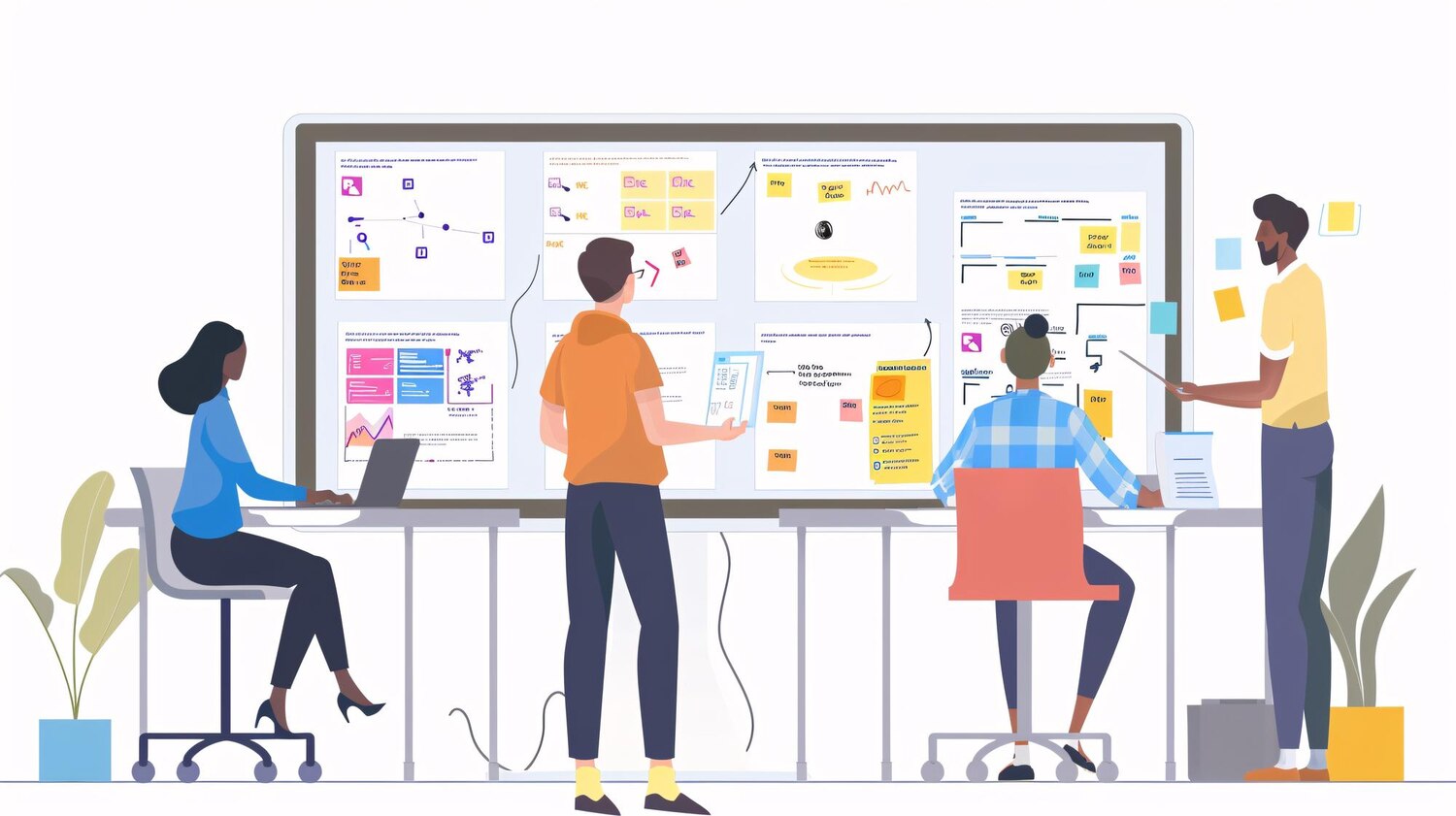
Next, stack-rank constraints. Which legal or regulatory requirements are truly non-negotiable? Which integration dependencies are long poles? Who owns the data that matters most? Call these out early and plan the sequence accordingly. Your roadmap should place the riskiest bets where you have the most time to course-correct. It’s amazing how many projects discover a blocking vendor API in month five that could have been spiked in week two.
Validation must be continuous, not ceremonial. Avoid research theater—pretty decks and surveys with leading questions. Put working software in front of actual users with logging that reveals what they do, not what they say. Tie key events into your analytics pipeline on day one so you can observe changes in the metrics you care about. When strategy is grounded in behavior, custom software development earns its keep in board reports, not just demos.
Scoping Without Guesswork: From Problems to Requirements
Great scope reads like a contract with reality. It says what the product will accomplish in context, how we’ll measure it, and what we’re explicitly not doing yet. Requirements that skip context are magnets for rework. A crisp scope starts with a problem statement, followed by the actors, the workflows, and the constraints that actually bite. Only then do we talk about solutions. When teams invert that order, they ship features that look right but do nothing.
Replace “nice to have” with a trade-off table. For each candidate capability, list the value, the risk, and the dependencies. If a feature’s value is speculative and the dependencies are brittle, either spike it early or push it out of the first release. Where dependencies touch the web experience, align with your site platform decisions; sometimes the cleanest path is to leverage proven foundations from your website stack while building the differentiating logic as services. If you need a partner for that baseline, see the practical options at website design and development.
Scope isn’t static. Set a cadence for scope reviews where product, engineering, and design interrogate the latest learning against the original assumptions. Retire requirements that are no longer material to the outcomes, and expand the ones that prove valuable. When budget or time is tight, incremental scope done well beats wishful big-bang planning. If your core need leans deeper than the web layer, experienced teams focused on custom development keep the backlog honest and the non-essentials out.
Architecture Choices That Age Well
Architecture is a product decision wearing a technical coat. It either accelerates future bets or taxes them. Rather than chasing fashion, pick the least complex architecture that protects your critical qualities: reliability, correctness, performance, compliance, and time-to-change. Microservices are powerful but expensive to operate; a modular monolith with well-defined boundaries is often a better starting point. You can split modules when the seams prove stable. There’s a reason seasoned architects treat cohesion and coupling like bank accounts that earn compound interest.

Data deserves first-class thinking. Model your core domain with terms the business actually uses, not whatever your ORM defaults suggest. Event-driven patterns help when workflows cross boundaries and latency matters. They also demand discipline around idempotency and observability. Pay back the operational complexity by capturing business events that your analytics team can mine later. For reference material on service decomposition and trade-offs, the microservices overview is a reasonable starting point, but don’t outsource judgment to trends.
Choose technologies your team can operate half-asleep during an incident. Pick cloud services that reduce undifferentiated work without locking you out of portability. Automate the paved road—CI, CD, static analysis, policy checks—then enforce it for every repo. Architecture that ages well is rarely flashy; it’s boring in the best way. And when stakeholders ask why you didn’t use the shiny thing, you’ll have crisp answers rooted in trade-offs and the outcomes promised by your custom software development roadmap.
Build Versus Buy Versus Integrate
There are only three levers: build the capability, buy a product, or integrate a service. Each lever trades cash for control and time. Build where differentiation lives, buy where the market is mature and your needs are common, and integrate where a third party can absorb the non-core complexity. That framing sounds simple until incentives collide. Sales wants features yesterday, finance wants predictability, security wants fewer surface areas, and operations wants fewer vendors. Reconcile those needs with a decision memo that captures the reasoning and the expected revisit date.
Integration is often the underestimated hero. If you can stitch together billing, subscriptions, identity, and email without writing them from scratch, your team focuses on your unfair advantage. The catch is that integrations become part of your reliability story. They need monitoring, timeouts, retries, fallbacks, and runbooks. Treat them as first-class dependencies with contract tests and staging environments. If the heart of your value is workflow automation or data sync, a partner specialized in automation and integrations will save you quarters, not weeks.
E-commerce is a common case where build/buy/integrate fights are loudest. Checkout, tax, and fraud are solved problems; merchandising logic, dynamic pricing, and post-purchase experiences usually are not. Buy the commodity, then build the pieces where you want to be incomparable. If you’re scaling that retail engine, the platform options at e-commerce solutions can anchor the stack while you focus on the differentiators.
Delivery Mechanics: Teams, Tooling, and Cadence
Delivery is where strategies cash their checks. You can’t manage what you can’t see, so make work visible and small. Tranches of two to five days per ticket are long enough for flow yet short enough to surface risk quickly. Invest in a test pyramid that favors fast unit and contract tests, with a thin UI layer for critical paths. Pair programming isn’t a religion, but pair for new patterns and risky changes. Assign steady owners to shared libraries to keep quality from diffusing into a trench war of styles.
Cadence matters more than velocity. Use weekly or biweekly releases supported by automated pipelines that enforce linting, security scans, and migration checks. Don’t gate everything behind a change board; gate behind paved-road policies that embed your rules into the tooling. Run incident drills and postmortems where action items have owners and due dates. The goal isn’t zero incidents—it’s short mean time to recovery and clear learning. Teams that fear production never learn what their software does in the wild.
Stakeholders crave transparency, not dashboards that lie. Publish a living roadmap with status, risks, and decisions. Tie features to outcomes and share the logs that matter. When expectations shift, adjust scope openly instead of burying compromises. That’s how trust accumulates. In custom software development, predictability is the product you sell internally; the application is the artifact your customers see.
Data, Analytics, and Performance You Can Trust
Data work doesn’t start after launch; it starts when you write the first API. Decide what events represent success, failure, and learning. Instrument those events with consistent schemas and correlation IDs so you can trace behavior across services and clients. Put guardrails on privacy early—mask sensitive fields in logs, use role-based access, and document data lifecycles. Nobody ever regrets establishing observability conventions; they only regret doing it after the third incident.
Analytics should answer the questions the business asks every week. How fast do new accounts activate? Which step in onboarding leaks the most? What’s the ratio of self-serve resolution to support tickets? Design your data model to make these queries cheap. Then, expose the dashboards that matter and archive the rest. Performance belongs in the same conversation. Latency budgets should exist for every critical path, and load tests should simulate realistic user journeys, not just synthetic hammering.
If your team needs a performance backbone and clear instrumentation, bring in specialists who live in this space. The offerings at analytics and performance focus on the reality of multi-service systems: tracing across boundaries, budgeting for cold starts, and proving improvements statistically rather than anecdotally. When analytics and performance practices are first-class, custom software development turns into a continuous loop of evidence-driven decisions, not a debate fueled by opinions.
Pricing Models for Custom Software Development
Every pricing model is a risk-sharing agreement. Fixed price sounds safe until change arrives. Time-and-materials feels open-ended until you enforce outcomes and transparency. A pragmatic approach uses the right model for the right phase. Discovery and architecture align well with a fixed fee and clear deliverables: problem framing, solution options, cost-of-delay, and a baseline backlog. Build phases benefit from time-and-materials with guardrails: defined sprint budgets, explicit exit criteria, and a mechanism to pause or pivot when the data says so.
Clients often try to push unknowns into a fixed price. Vendors respond by padding estimates or narrowing scope until the contract is a booby trap. Trade the illusion of certainty for mechanisms that surface reality fast. Put price-protection into your process, not the calendar. For example, cap weekly spend, require a demoable increment every iteration, and tie continuation to leading indicators. That’s far more protective than a date attached to a guess. When custom software development is funded as a series of small, verified bets, both sides sleep better.
There’s also room for outcome-based bonuses. If conversion lifts by an agreed threshold, or the team eliminates a measurable ops cost, share the upside. Incentives shape behavior, and aligned incentives shape it in your favor. If your custom work powers a revenue engine—say a new checkout or subscription flow—pair contract structure with a stable commerce foundation from e-commerce solutions so you’re not betting everything on bespoke underpinnings.
Governance, Handover, and Long-Term Ownership
Governance isn’t bureaucracy; it’s how you make decisions without relitigating them. Establish a lightweight architecture review for changes that touch shared boundaries. Keep a playbook for incident response, data access, and disaster recovery. Document the “why” behind design choices in living ADRs that fit on a page. If it takes a novel to explain a system, it’s either too complex or under-practiced. The handover you want at the end is one your team already rehearsed by operating the system from the first release.
Ownership doesn’t start at launch; it starts at the first line of code. Keep product, design, and engineering in the room for trade-off calls. Rotate on-call with support from seniors until the muscle memory is built. Define service-level objectives and stick to them when prioritizing work. That’s how you avoid the “it’s done but nobody can run it” failure mode. Branding also matters more than most teams admit; name services clearly, align UI states with your visual identity, and treat your platform as a product the company understands. If you need help establishing a coherent face to customers, the team behind logo and visual identity can keep the experience consistent while engineering keeps moving.
Expect change. Regulations shift, vendors evolve, and your own priorities will turn over every quarter. Good governance makes those changes less scary by giving you a rhythm for revisiting assumptions. Keep contracts and SLAs handy, run vendor exit drills annually, and archive dead features rather than letting them fossilize in your codebase. With that discipline, custom software development stays an asset that appreciates with your business, not a liability you quietly dread.